
You know the feeling. You’re halfway through a cross-country flight, deep into a work presentation, or navigating an unfamiliar city and your phone drops to 12%. That small red battery icon triggers something close to a primal response. Your shoulders tighten. You start rationing screen time. You scan the terminal for an open outlet like it’s a survival game.
Low-battery anxiety is real, and it has been a defining frustration of the smartphone era. But a quiet materials revolution is underway, and it has a name most people haven’t heard yet: silicon-carbon battery technology. This is not a minor tweak. It is the most meaningful shift in battery chemistry since lithium-ion cells became standard in consumer electronics more than two decades ago and it is already showing up in the phones and laptops people are buying right now.
Why Lithium-Ion Hit a Wall
To appreciate what silicon-carbon batteries actually do, it helps to understand why the technology they are replacing reached its limits.
Standard lithium-ion batteries use a graphite anode — the negative electrode where lithium ions are stored when you charge your device. Graphite has served this role reliably for over 30 years. The problem is that it has a theoretical storage capacity of about 372 mAh/g, and the industry has essentially squeezed everything it can out of that number. Manufacturers have made incremental gains by refining electrolyte chemistry, improving cathode materials, and engineering thinner separators. But the fundamental ceiling imposed by graphite has not moved.
Meanwhile, everything else about your device has gotten hungrier. Brighter displays, 5G radios, always-on processors, sophisticated camera systems — the power demands of modern smartphones have outpaced what graphite-based cells can comfortably supply without making your phone the size of a brick. The industry needed a new anode material. It found one in silicon.
What Makes Silicon So Powerful and So Tricky
Silicon is, theoretically, a battery engineer’s dream material. It can store roughly ten times more lithium ions than graphite, which translates directly into dramatically higher energy density. While a standard lithium-ion battery tops out at around 387 Wh/kg theoretically, silicon-carbon batteries can approach 600 Wh/kg. In practical terms, that means significantly more stored energy in the exact same physical volume.
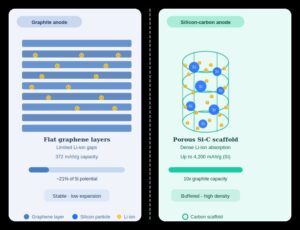
There is, however, a catch that kept silicon out of commercial batteries for years. When silicon absorbs lithium ions during charging, it expands — by as much as 300 percent. When it releases those ions during discharge, it contracts. Do that a few hundred times and the silicon structure begins to crack, shed particles, lose electrical contact, and degrade rapidly. Early silicon-only anodes had impressive initial capacity but terrible cycle life, making them commercially useless.
The breakthrough came from combining silicon with carbon. Carbon acts as a structural buffer — a flexible scaffold that cushions silicon’s expansion and contraction while maintaining electrical conductivity throughout the cell. The result is a silicon-carbon composite anode that captures most of the energy density benefits of silicon while preserving the structural durability needed for a battery that has to survive thousands of charge cycles over several years.
The Real-World Numbers That Matter
Lab results are one thing. What does this actually mean for your daily life?
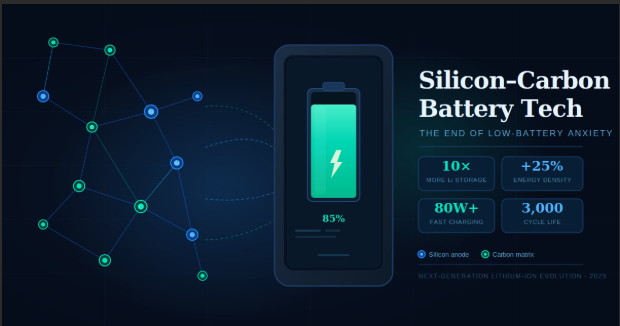
In commercial implementations, silicon-carbon batteries deliver roughly 10 to 25 percent more energy density than a comparable lithium-ion cell. That may not sound revolutionary, but consider what it means in practice. A phone that currently ships with a 5,000 mAh battery could, using the same internal space, offer a 6,000 to 6,500 mAh cell. Or manufacturers could keep capacity roughly the same and build a meaningfully thinner device.
The charging speed improvements are equally significant. Silicon’s conductivity characteristics enable lower internal resistance, which means batteries can accept charge at higher rates without generating excess heat. Many silicon-carbon equipped smartphones already support 80-watt-plus charging natively, getting you from near-empty to a substantial charge in around 30 minutes.
Cycle life, once silicon’s Achilles’ heel, has also improved substantially. Where early silicon-heavy designs struggled to reach 500 cycles with acceptable capacity retention, silicon-carbon composites now routinely achieve 1,500 to 3,000-plus cycles — comfortably covering a smartphone’s typical two-to-four-year lifespan.
Who Is Already Shipping This Technology
Silicon-carbon batteries moved from lab curiosity to commercial reality faster than most people realize. The first smartphones using this technology reached the global market in 2024, initially confined to premium flagship devices. By 2025, the picture had changed considerably, with manufacturers pushing the technology into mid-range price tiers.
Honor has been one of the most aggressive adopters. After launching a silicon-carbon battery with 10 percent silicon content in 2024, the company announced an updated design with 25 percent silicon content, just 2.3mm thick, and 6,100 mAh capacity — enough for over 35 hours of rated usage. That battery debuted in the Honor Magic V5 and was named one of Time magazine’s Best Inventions of 2025.
OnePlus, Xiaomi, and Nothing have also rolled out silicon-carbon equipped handsets, with each generation pushing higher silicon ratios and tighter thermal management. Electric vehicle manufacturers are not sitting still either. Tesla has been exploring silicon-carbon cells for automotive applications, and CATL the world’s largest battery manufacturer has developed silicon-carbon products targeting both EV and consumer electronics markets.
The PC industry is beginning to follow. Laptop manufacturers are starting to explore silicon-carbon cells, and given that battery life consistently tops the list of buyer priorities in consumer laptop surveys, the incentive to adopt is strong.
The Engineering Challenge No One Talks About
For all its promise, silicon-carbon battery manufacturing is not a simple swap. The uniform dispersion of silicon nanoparticles within the carbon matrix requires sophisticated preparation techniques, and maintaining consistency at scale is a significant engineering challenge. Variations in silicon distribution can lead to uneven expansion during charging, which accelerates degradation in ways that are difficult to detect until a battery is already in the field.
Thermal management also demands attention. While silicon-carbon batteries generally run cooler than graphite cells during fast charging due to lower internal resistance, the expansion dynamics of silicon introduce mechanical stresses that, if unmanaged, can shorten the battery’s usable life. Manufacturers address this through precise electrode design, engineered void spaces within the anode structure that accommodate silicon’s volume changes, and advanced battery management software that controls charge rates based on temperature and cycle history.
The cost premium is real but shrinking. Silicon-carbon cells currently carry higher manufacturing costs than graphite-based equivalents, which is why the technology appeared in premium devices first. As production scales and fabrication processes mature, the cost gap is expected to narrow significantly. Most industry analysts expect silicon-carbon to become the default anode technology across mid-range and eventually budget devices within the next three to four years.
Beyond Smartphones: Where This Is Headed
Low-battery anxiety is not exclusively a smartphone problem. Laptop users have been conditioned to hunt for power outlets in coffee shops and airports just as obsessively as phone users. Wearable devices like smartwatches and fitness trackers are constrained by the physical volume available for a battery. Hearing aids, medical wearables, and augmented reality glasses all face the same fundamental constraint: the battery takes up space and weight that users would rather not carry.
Silicon-carbon technology addresses all of these use cases simultaneously. By packing more energy into a smaller physical footprint, it opens design possibilities that simply were not available with graphite cells. Honor has already announced plans to bring its silicon-carbon cells to watches and PCs. The broader trajectory points toward a device ecosystem where battery life is measured in days rather than hours, charging becomes a once-daily or less habit, and range anxiety whether on a phone or in an electric vehicle becomes a relic of an earlier technological era.
What This Means If You Are Buying a Device Today
If you are currently in the market for a new smartphone or laptop, silicon-carbon battery capacity is worth researching explicitly. Not all manufacturers advertise the anode chemistry prominently, but specifications pages and independent reviews increasingly flag it. Devices with silicon-carbon cells are delivering measurably longer screen-on times, faster recharge speeds, and in many cases slimmer form factors than their graphite-battery predecessors.
It is also worth noting that the technology is still maturing. Devices from early adopters like Honor, OnePlus, and Xiaomi represent first and second-generation implementations. The engineering refinements arriving in 2025 and 2026 models reflect hard-won lessons about silicon percentage, thermal design, and software-level charge management. If you can wait a product cycle, you will likely get a more polished implementation. If you cannot — and the current options are already meaningfully better than what graphite-based competitors offer.
The End of a Small But Persistent Stress
Low-battery anxiety has been normalized to the point where most people accept it as a feature of modern life. It does not have to be. The engineering problem was never unsolvable it was simply waiting on the right materials science.
Silicon-carbon batteries represent that solution, not as a distant prototype but as a commercially available technology already in millions of devices. The numbers are compelling, the trend line is clear, and the manufacturing momentum is building. Within a few years, the idea that your phone might not make it through a full day on a single charge may feel as antiquated as carrying a spare battery pack or hunting for a wall outlet in the middle of an airport.
The red battery icon still exists. But for the first time in a long time, the technology needed to make it irrelevant is already here.
Recommended: Why Is My Phone Charging Slowly? 7 Fixes That Actually Work