
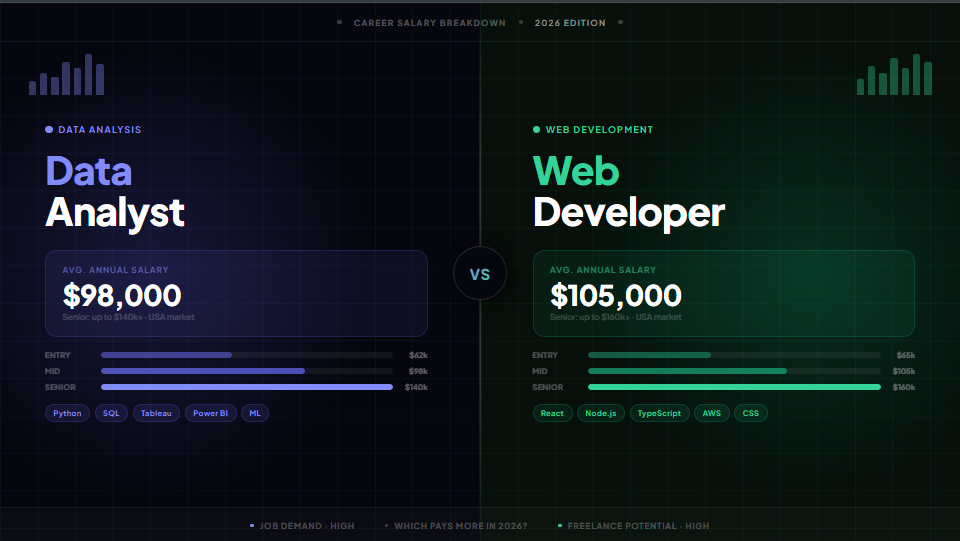
The debate between data analysis vs web development is one of the most common career questions in tech right now. Both paths are in demand, remote-friendly, and well-compensated but which one actually pays more? This guide breaks down real 2026 salary data at every experience level so you can make an informed decision.
So which one actually pays more? The short answer is that it depends on your experience level, your industry, and where you live. But the longer answer which is what this guide gives you, it reveals some important differences in how each career grows over time, which path reaches six figures faster, and where the real earning ceilings are.
This is not a generic comparison. Every salary figure in this article comes from current 2026 data pulled from the Bureau of Labor Statistics, Glassdoor, Payscale, and Coursera’s salary research. Let’s get into it.
What Each Role Actually Does
Before comparing salaries, it helps to understand what you would actually be doing day to day in each role because the work is fundamentally different, and that difference matters when choosing a career you will spend years in.
Data Analyst
A data analyst collects, cleans, and interprets large sets of information to help organizations make better decisions. In practice, this means spending a significant portion of your day inside tools like SQL, Python, Excel, Tableau, or Power BI, writing queries, building dashboards, identifying trends in numbers, and presenting those findings to people in marketing, finance, operations, or leadership who need to act on them.
The role is fundamentally business-facing. You are not building a product, you are helping the people who run a business understand what is working, what is not, and where the opportunities are. If you enjoy problem-solving through data, working across departments, and presenting insights that directly shape company strategy, this side of the comparison tends to feel like a natural fit.
Web Developer
A web developer builds and maintains websites and web applications. Depending on your specialization, that could mean writing the code that controls how a website looks and behaves in a browser (front-end development), building the server-side logic and databases that power an application (back-end development), or doing both (full-stack development).
The day-to-day work is largely code-focused. You spend your time writing HTML, CSS, JavaScript, and potentially languages like Python, Ruby, or PHP, depending on the stack your employer uses. The feedback loop is more visual and product-oriented, you build something, it either works or it does not, and you can see the result directly. If you prefer building things rather than analyzing them, and enjoy the satisfaction of shipping a functional piece of software, web development is where that preference leads.
Data Analysis vs Web Development: Entry-Level Salary
The first year in either career is where most people start, and the salary ranges at this stage are closer than many people expect.
Entry-Level Data Analyst Salary (0–2 Years)
According to current 2026 data from multiple sources including Glassdoor and BLS-adjacent occupational surveys, entry-level data analysts in the United States earn between $62,000 and $74,000 annually. Payscale’s data, based on over 1,400 verified salaries, puts the starting figure at approximately $63,500 for analysts with less than one year of experience.
Location matters significantly at this stage. Entry-level analysts in San Francisco, Seattle, or New York can start at $80,000 to $90,000 or higher, while the same role in smaller markets may begin closer to $55,000. Analysts who specialize early in high-demand areas particularly Python, machine learning foundations, or financial data analysis, earn at the upper end of this range even in their first year.
Entry-Level Web Developer Salary (0–2 Years)
Entry-level web developers in the United States earn between $52,000 and $80,000 depending on specialization and location, according to 2026 Bureau of Labor Statistics data and Glassdoor salary reports. Glassdoor’s entry-level range based on over 27,000 salary contributions runs from $50,600 to $128,000, with the 25th to 75th percentile sitting between $77,000 and $132,000 when all experience levels are averaged.
For strictly entry-level developers, Payscale puts the figure at $57,800 for those with under a year of experience, slightly lower than the entry-level data analyst figure. However, developers who specialize in high-demand frameworks like React or Node.js can boost that starting salary by $8,000 to $12,000 according to 2026 job posting analysis. Remote positions also average 15 to 20% higher than local market rates, which has become a significant factor in web development compensation since 2022.
Entry-Level Verdict
At the starting line, data analysis has a slight edge on base salary in many markets, particularly for analysts who enter with a strong SQL and Python foundation. Web development catches up quickly for those who specialize in sought-after frameworks, and remote opportunities are more consistently available in development than in analytics at the junior level.
Data Analysis vs Web Development: Mid-Level Salary
This is where both careers start to separate from each other more meaningfully, and where the choice of industry begins to have a significant impact on compensation.
Mid-Level Data Analyst Salary
Mid-level data analysts with three to five years of experience earn between $80,000 and $99,000 annually on average. Glassdoor’s current data puts the average data analyst salary at $93,217 per year as of May 2026, with the 25th to 75th percentile running from $72,000 to $121,000. Industry is the biggest variable at this stage.
According to 2026 hiring data, mid-level analysts in tech and software earn around $112,000 on average, well above the overall median. Financial services is close behind, with analysts at investment banks and financial technology firms regularly clearing $110,000 to $130,000 by their fourth year. Healthcare and consulting sit in the middle, while retail and nonprofit sectors tend to pay $70,000 to $85,000 at the mid-level regardless of years of experience.
Mid-Level Web Developer Salary
Mid-level web developers earn between $78,000 and $114,000 per year, with research from Research.com reporting a median near $78,000 for this experience group and analysis from nucamp.co putting many mid-level developers closer to $112,000 based on 2026 role data. The BLS projects web developer employment to grow 13% through 2034, indicating continued strong demand that keeps mid-level salaries competitive.
Full-stack developers consistently earn more than front-end or back-end specialists at this stage, with mid-level full-stack roles ranging from $90,000 to $120,000 in most markets. Developers who add DevOps skills, AWS, Docker, containerization or expand into mobile development see faster progression to senior pay bands.
Mid-Level Verdict
At the mid-level, both paths are genuinely competitive, with substantial overlap in the $85,000 to $110,000 range. Data analysts in tech and finance pull ahead of the general web developer average. Web developers who have specialized in full-stack or cloud-adjacent work keep pace with or exceed data analyst salaries in the same industries. The industry you work in matters more at this stage than the specific job title.
Data Analysis vs Web Development: Senior-Level Salary
This is where the two paths diverge most clearly and where the long-term earning potential of each career becomes most visible.
Senior Data Analyst Salary
Senior data analysts with five or more years of experience earn between $98,000 and $150,000+ per year. Glassdoor data from May 2026 shows experienced data analysts at the highest seniority level earning between $82,000 and $166,000, with top earners at the 90th percentile reaching $153,000. The BLS-reported median for operations research analysts, the closest federal category to data analyst work sits at $90,440, with the top 10% earning over $174,000.
Senior analysts who advance into data science, machine learning, or analytics leadership roles see the most dramatic salary increases. Coursera’s 2026 salary guide notes that analytics managers and data architects earn significantly above the senior analyst range, often clearing $130,000 to $160,000. Machine learning skills are reported to add approximately 25% to base salary, and deep learning expertise adds around 30%.
Senior Web Developer Salary
Senior web developers with seven to nine years of experience earn between $111,000 and $182,000 per year according to Coursera’s 2026 web developer salary guide. Research.com’s analysis of senior developers with ten or more years of experience puts the range at $90,000 to $150,000, with top earners exceeding that threshold in leadership roles.
Specialization drives significant variation at the senior level. Senior front-end engineers in high-demand sectors earn $100,000 to $140,000. Full-stack developers command $110,000 to $150,000 in most markets, with fintech and healthcare pushing toward the top of that range. Web development managers overseeing teams earn $130,000 to $170,000, and technical directors in finance or healthcare routinely exceed $160,000. Glassdoor’s current data shows the senior web developer range at $107,000 to $172,000 for professionals with eight or more years of experience.
Senior-Level Verdict
Senior web developers and senior data analysts have comparable base salary ceilings in most industries. Web development pulls ahead in total compensation at the highest levels particularly in major tech companies where equity and bonuses are standard while data analysis offers a clearer path to adjacent high-paying roles like data science, machine learning engineering, and analytics leadership that can push well past $150,000.
Full Salary Comparison Table: Data Analyst vs Web Developer
| Experience Level | Data Analyst (US Average) | Web Developer (US Average) | Edge |
|---|---|---|---|
| Entry Level (0–2 years) | $62,000 – $74,000 | $52,000 – $80,000 | Slight edge to Data Analyst |
| Mid-Level (3–5 years) | $80,000 – $99,000 | $78,000 – $114,000 | Comparable; depends on industry |
| Senior Level (5–8 years) | $98,000 – $150,000+ | $111,000 – $182,000 | Slight edge to Web Developer |
| Top Earners / Specialists | $150,000 – $174,000+ | $160,000 – $337,000+ | Web Developer in major tech hubs |
| Average National Salary (all levels) | ~$93,000 (Glassdoor 2026) | ~$100,000 (Glassdoor 2026) | Slight edge to Web Developer |
Sources: Glassdoor (May 2026), Payscale (2026), Bureau of Labor Statistics, Coursera Salary Guide, nucamp.co, codingtemple.com, fueler.io
Which Career Reaches $100,000 Faster?
This is the question a lot of career changers are really asking, and the answer is more nuanced than a single number suggests.
For data analysts, reaching $100,000 typically requires three to five years of experience, combined with specialization in a high-paying industry (tech or finance) or in high-demand skills like Python, machine learning, or advanced visualization tools. Analysts who pivot toward data science after three years can accelerate this timeline significantly. Entry-level salaries starting at $62,000 to $74,000 mean a $100,000 salary is roughly two significant pay increases away for most people.
For web developers, the path to $100,000 is closely tied to specialization. A full-stack developer or a React specialist in a tech-adjacent industry can reach $100,000 within three to four years. A front-end developer at a smaller company in a non-tech market may take longer. The good news for developers is that remote work, which is consistently available in web development — allows people in lower-cost markets to earn salaries benchmarked against higher-paying cities, which compresses the timeline meaningfully.
Based on the data, web developers with the right specialization can reach $100,000 slightly faster than data analysts on average but both paths can realistically hit that milestone within three to five years for people who develop strong skills and target the right industries.
Beyond Base Salary: Other Financial Factors to Consider
Salary is only part of the financial picture. A few additional factors separate the two careers in ways that base pay comparisons do not capture.
Freelancing and Contract Work
Web development has a longer and more established freelance market. Skilled developers can charge $50 to $150 per hour for contract work, and platforms like Upwork and Toptal create accessible pipelines for project-based income outside a full-time job. Building client projects independently is a realistic path to significantly increasing your total annual income beyond a salaried position.
Data analysts can freelance, but the market is smaller and the projects are often shorter-term. Experienced freelance analysts charge between $35 and $80 per hour, with longer-term contracts running $5,000 to $10,000 per month for established professionals. The path exists but requires more effort to build compared to development freelancing.
Remote Work Availability
Both careers are remote-friendly, but web development has historically had more consistently available remote positions across all experience levels. Data analyst remote roles are increasingly common, particularly at tech companies, but some organizations still require analysts to be present for stakeholder meetings and collaborative decision-making sessions.
Equity and Bonuses at Tech Companies
Web developers at major technology companies particularly full-stack and back-end engineers frequently receive equity compensation in addition to base salary. Total compensation packages at companies like Google, Meta, or Amazon can push annual pay well above base salary through stock grants and performance bonuses. Data analysts at the same companies receive equity as well, but the packages tend to be more modest than those offered to software engineers and developers.
Career Transition Potential
Data analysis offers a clearer upgrade path into higher-paying adjacent roles. Moving from data analyst to data scientist adds $20,000 to $40,000 in median salary. Moving into machine learning engineering or AI-focused roles can push compensation significantly higher, the BLS reports a median of $112,560 for data scientists, with senior roles and total compensation at major tech companies reaching $200,000 to $450,000.
Web developers have a parallel path into software engineering, which also commands higher compensation. The BLS reports a median salary above $129,000 for software engineers, and senior engineers at major tech companies earn well above that with equity factored in. Both upgrade paths are viable; the data analysis path into AI and machine learning is experiencing faster salary growth right now given current industry demand.
Job Market and Growth Outlook
Salary today matters, but so does whether the field will keep growing over the next decade.
The BLS projects web developer employment to grow 13% through 2034, nearly double the average growth rate for all occupations. The web developer job market added over 15,000 new positions in 2025 alone, and 67% of hiring managers reported difficulty finding qualified junior candidates in 2026 according to the Stack Overflow Jobs Report. That persistent hiring difficulty keeps salaries competitive even at the entry level.
Data analytics growth is even more pronounced. Analytics roles tied to data science are projected to grow 23% through 2033, and the World Economic Forum’s 2026 Jobs Report identifies AI and big data as the top fastest-growing skill areas globally. Entry-level data analyst salaries have risen by approximately $20,000 since 2024, and analysts who adapt to AI-powered workflows are positioned for above-average salary growth going forward.
Both fields have strong growth trajectories. Data analytics has the faster projected growth rate, driven by AI integration and the increasing centrality of data to business decisions. Web development has a larger absolute number of open positions at any given time, creating more consistent hiring volume for job seekers at all levels.
Which Career Should You Choose Based on Salary Alone?
If the only question is which career pays more, here is the honest answer based on the 2026 data:
Web development pays more at the top end: particularly for full-stack and back-end developers at major tech companies, where total compensation including equity can reach figures that most data analyst roles do not match. The highest-paid senior web developers in San Francisco and New York earn more than their data analyst counterparts at comparable seniority levels.
Data analysis offers faster salary growth over time: particularly for analysts who specialize in AI and machine learning. The upgrade path from data analyst to data scientist to machine learning engineer is one of the highest-compensation career arcs available in tech right now, and the salary growth from $65,000 to $150,000+ is achievable in five to seven years for disciplined professionals.
At the entry and mid-level, the salaries are close enough that salary alone should not decide your choice. The $5,000 to $10,000 difference between the two at the starting level is unlikely to outweigh factors like which type of work you actually enjoy, which skill set you will develop faster, and which career you are more likely to stay in long enough to reach the senior level where the real compensation differences appear.
Skills That Increase Your Salary in Each Field
If you have already chosen a path and want to know which skills to prioritize for maximum earning potential, here is what the data shows.
For Data Analysts
- Machine learning skills add approximately 25% to base salary
- Deep learning expertise adds around 30%
- Cloud platform proficiency (AWS, Azure, Google Cloud) adds 20%
- Python proficiency beyond basic analysis puts you at the top of job posting salary ranges consistently
- SQL combined with visualization tools (Tableau, Power BI) is the minimum baseline — specializing beyond it is what separates $75,000 from $110,000
For Web Developers
- React or Vue.js specialization adds $8,000 to $12,000 to starting salary in 2026
- Full-stack capability (combining front-end and back-end skills) adds $15,000 to $30,000 over front-end-only roles at mid and senior levels
- DevOps skills (AWS, Docker, CI/CD pipelines) accelerate progression to senior roles and push compensation into the $120,000 to $150,000 range faster
- Node.js and TypeScript proficiency is increasingly standard at the senior level and expected by most high-paying employers
- Computer science degree holders average 12 to 18% more than bootcamp graduates at the entry level, though this gap narrows within two to three years
Final Verdict: Which Pays More?
Based on the full 2026 salary data, web development has a slight overall edge in national average pay, approximately $100,000 versus $93,000 across all experience levels per Glassdoor. At the top of each career, senior developers in major tech markets can earn more than senior data analysts in equivalent roles. And for freelance income, web development offers a deeper and more accessible independent market.
However, data analysis is growing faster, the AI-related upgrade paths are producing some of the most rapid salary gains in tech right now, and the entry-level salary comparison strongly favors analysts in most markets. If the goal is maximum long-term earnings through career progression rather than raw starting pay, data analysis into data science into machine learning is arguably the higher-ceiling path over a ten-year horizon.
The most honest takeaway: neither career pays dramatically more than the other across the board. The difference is less about the job title and more about which industry you work in, how quickly you specialize, and whether you stay long enough to reach the senior level where the real compensation differences become meaningful. Pick the one you will actually get good at, that is the one that pays more in practice.
was this article helpful?